Art of Japan
 |
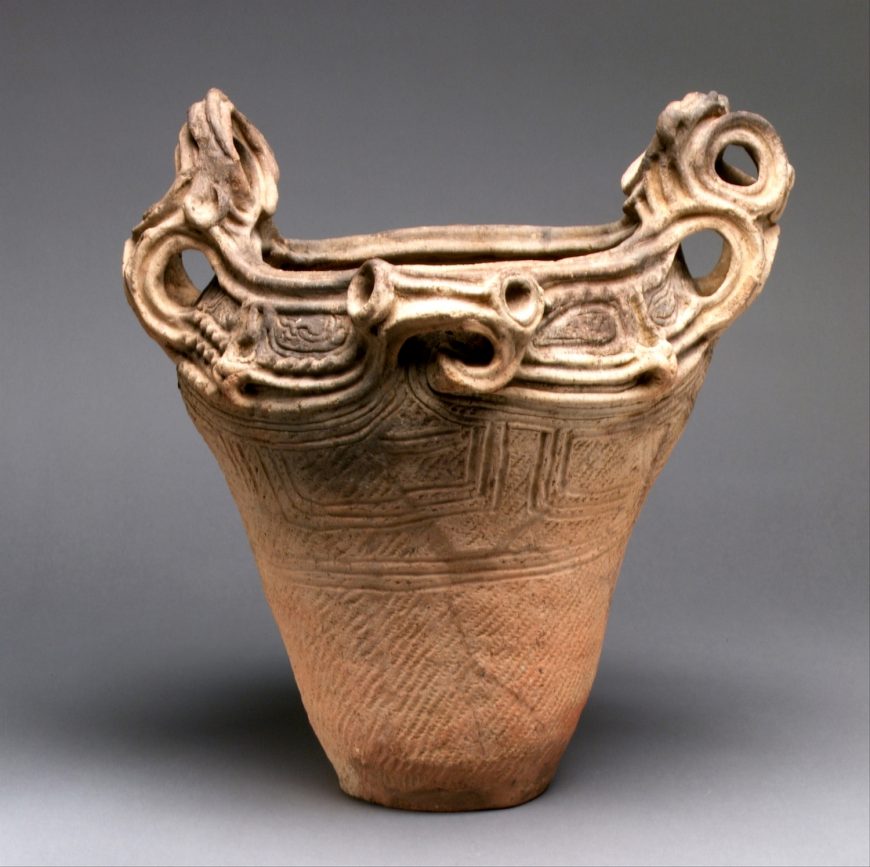
| Flame-rimmed” deep bowl, Middle Jomon period (c. 3500–2500 B.C.E.), earthenware with cord-marked and incised decoration, 13 inches tall (The Metropolitan Museum of Art) |
 |
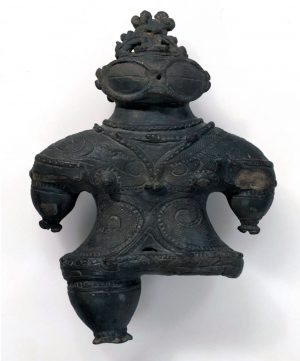
Goggle-eyed”-type dogū figurine, late Jōmon period (1,000- 400 B.C.E.), excavated in Tsugaru city, Aomori prefecture, Japan, clay, H. 34.2 cm (Tokyo National Museum, Japan) |
The Jōmon period, which occurred from c. 10,500 to c. 300 B.C.E, is known as Japan's Neolithic period. To sum it up, this period was all about grasping onto the world and creating a new one. More specifically, men hunted and fished for their food, while women made clay pots by hand. In Japanese, Jōmon stands for "cord pattern", which is the technique of creating pottery that from this period. Pots like the one depicted in the first picture were made by wet coils that were smoothed inside and out and finished with geometric patterns.
Later in the Jōmon period, pottery became more complex. These pieces consisted of precise decorations and were colored with natural pigments, which is shown in the second picture depicted above. The clay figure in the second picture is known as a dogū: which represent actual people, typically women. As you can see, the dogū above consists of wide, bug eyes, a thin waist, and wide hips. Some dogūs consist of large abdomens, which suggest pregnancy. In the picture, you can see markings that are tattooed the woman. These markings may represent spiritual rituals such as the image of goddesses.
The reading mentions that images of the female body as symbols of fertility were common in many parts of the world during the Neolithic period. This is interesting to me because portraying women to be a certain way has been a common theme in many other cultures that we have learned about in this class. Furthermore, this is a theme that is still alive in our society today. All women are expected to have the same body: a thin waist, a nice chest, and a big butt. However, that is not the reality and this ideology is damaging to many women.
It is hard to believe, but I think the ideas that the people have in our society today come from common themes that were created long ago. I wonder if there will be a day that a generation can make these ideas come to an end. Lastly, I am curious if there are still clay pieces made like the ones above in our society. The Neolithic period occurred long ago, but artistic ideas and themes are still apparent in our society today.
1. Coman, D., & Coman, D. (2020). A brief history of the arts of Japan: The Jomon to Heian periods. Retrieved October 22, 2020, from https://smarthistory.org/japan-jomon-heian/

Great job Amanda! Both of those figures are really interesting, especially the google-eyed figurine. The material, detail, and intricate execution makes it understandable why these pieces are still admired. Great job!
ReplyDeleteThe googly eye figurine is for sure my favorite, although in today;s age it could be seen as a way to depict the ideal body it is used as a means to celebrate the female body in all of its glory
ReplyDeleteAmanda, this is a well written post. I think it's so true that the ideals of women's bodies has always been an issue. I enjoy artworks and cultures that idealise many different body shapes. It definitely does go to show that the ideals we have now are certainly not just modern problems. Good job!
ReplyDelete