 |
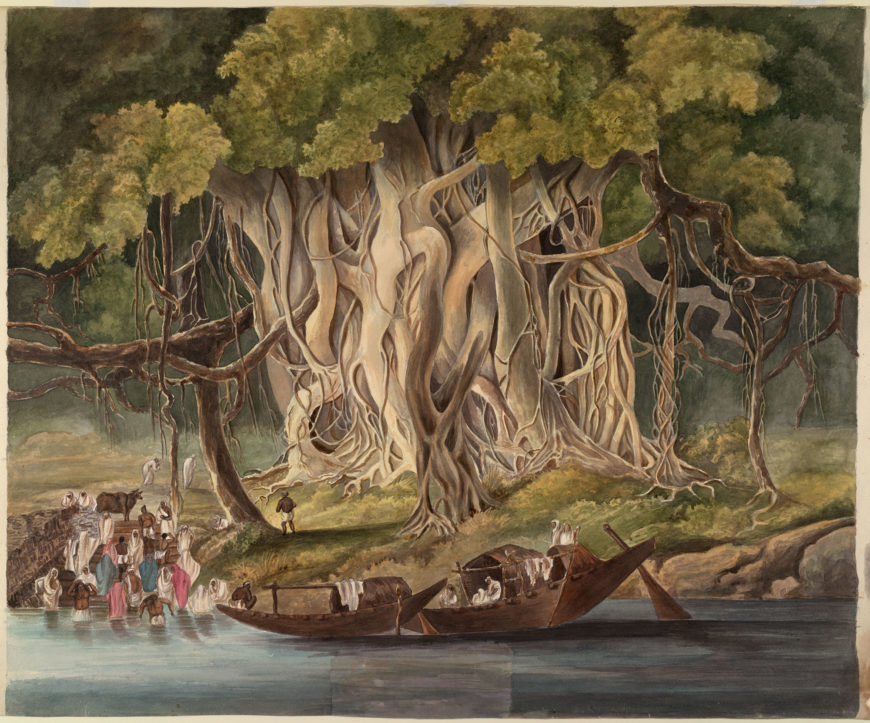
| Painting of a large banyan tree, showing the numerous intertwined aerial roots reaching down to the ground creating an appearance of many trees when in reality it is just one tree; commissioned by Lieutenant-Colonel W.R. Gilbert, a Commandant of the Ramgarh Battalion based in Hazaribag, India, c. 1825, watercolor (British Library) |
 |
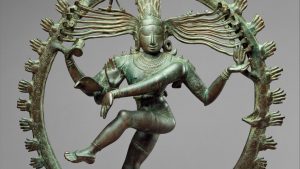
Shiva as Lord of the Dance (Nataraja), c. 11th century, Copper alloy, Chola period, 68.3 x 56.5 cm (The Metropolitan Museum of Art) |
Unlike Christianity or Buddhism, Hinduism does not consist of teachings from just one founder. Instead, Hinduism has diverse traditions that are constantly evolving. Hinduism is also unique because it does not follow a single text like the Christians follow the Bible. Since Hinduism does not have a specific teacher or text, this religion is hard to define.
The picture first picture depicted above is a painting of a large banyan tree from India in 1825. Although Hinduism is hard to define, a banyan tree is the perfect metaphor for this religion. Hinduism has many centers of life, some closely related to one another, and some not. Some centers of Hinduism are texts, deities, myths, rituals, festivals, codes of conduct, godly figures, and so on. The banyan tree gives us a visualization of how all of these different concepts come together as one, which helps us better understand Hinduism. As you can see, there are many different different roots. However, all of these roots are intertwined with one another to become one big tree. This tree also expresses the fact that even though many religions have come and gone, Hinduism continues to thrive by creating new ideas even if old ones have died away.
Within the Hindu religion are many gods, goddesses, and deities, with each one having a specific power or specialty. For example, the Brahman is the supreme god, Vishnu is the preserver, and Shiva is the destroyer. The second picture depicted above is a sculpture of Shiva, which is the god that is known to destroy. In this sculpture, Shiva is dancing, I wonder what dancing has to do with being a destoryer? This sculpture really helped me understand Hinduism more because it expressed that there are many gods for many different purposes, and it shows what the Hindus perceived these higher powers to look like.
I think Hinduism is especially unique because it is a very 'flexible' religion. It does not follow one specific text, it does not have a specific set of rules, and this religion constantly drops and adds new ideas to its belief system. I am most familiar with Christianity, so learning about Hinduism through its art really proved that Hinduism and Christianity are almost opposites. For example, Christian refers to one text: the Bible and one set of rules: the 10 Commandments. Meanwhile, Hinduism refers to many different texts and codes.
1. Rod-ari, D., & Rod-ari, D. (2020). Hinduism and Buddhism, an introduction. Retrieved October 09, 2020, from https://smarthistory.org/hinduism-and-buddhism-an-introduction/
2. Lipner, D., & Lipner, D. (2020). Sacred texts in Hinduism. Retrieved October 09, 2020, from https://smarthistory.org/sacred-texts-hinduism-2/


Hi Amanda!
ReplyDeleteI really liked your post! I liked how you showed the differences between Hinduism and religions like Christianity or Buddhism where there's a solid text(s) that can be relied upon for teachings. Hinduism is definitely a religion that is hard to define but I believe you did it quite nicely! I especially enjoyed how you described it, a tree with many roots that comes together as one. Great post!
I love that you chose the Banyan Tree as your artwork for this post. It is a most interesting metaphor for a religion that is pretty tough to pin down. The mythology behind this tree is even difficult to navigate because just like the many roots of the tree there are many Gods and stories surrounding it. Because nothing can grow underneath these trees they are also associated with Yama, the God of Death, and often are planted near crematoriums. I could actually write a full paper on this tree alone.
ReplyDeleteOn Shiva, I would have to say that he's dancing because he's having fun at work. Destruction doesn't mean death but rebirth, and if you've ever gotten ahold of bubble wrap, then you know it can be a blast to destroy.
I really enjoyed your post this week. It led me down a little bit of a "rabbit hole". Thanks!
Hi Amanda! Awesome post, I just wrote my post on Jatakas tales and in one of the tales of Bodhisattvas which is Buddhist, they mention a Banyan tree. So it is really interesting to see how you made a connection between religion and the Banyan tree. The prefect metaphor is right, that is so true. It is really interesting to see how Hinduism and Buddhism are so similar they are especially in art.
ReplyDeleteGreat post! I also wrote about this topic and I too was curious to why Shiva would be dancing if he was considered to be the destroyer. Seems to be a part of the never ending cycle of the universe being broken down and built again into something greater.
ReplyDelete