Saharan Art
 |
| Seated Figure, terracotta, 13th century, Mali, Inland Niger Delta region, Djenné peoples, 25/4 x 29.9 cm (The Metropolitan Museum of Art) |
Art discoveries from Sahara, a region in southern Africa, give insight on human and artistic evolution in African civilizations. Rock paintings that depicted domesticated animals prove that agriculture developed in southern Africa as early as 7000 B.C.E. However, these agriculture communities moved away when the Sahara began drying up around 3000 B.C.E. This led to the emergence of Egypt and Africa in the North. From then on, the Nile river (the world's longest river), hosted trade from central Africa to Egypt for as long as a thousand years.
Depicted above is a corpus of a sophisticated terracotta sculpture. These sculptures, found in present day Nigeria, provide the earliest evidence of a settled community with such artistic technology. The creations of this culture south of the Sahara are known as Nok. However, there is little to no information about the culture who created these sculptures. Additionally, many of these terracotta heads that were buried around 500 C.E have also been discovered in north eastern South Africa.
Since these sculptures were obviously so widespread in Africa, I wonder what their purpose was? Did they represent people who have died? Do they depict leaders? Are other terracotta sculptures portrayed in the same pose?
 |
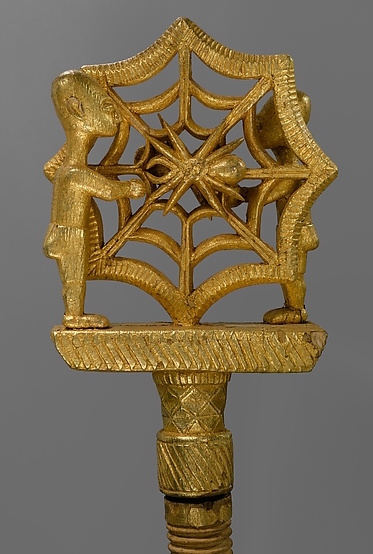
| Detail, Linguist Staff (Okyeame), 19th-early 20th century, Ghana, Akan peoples, Asante, gold foil, wood, nails, 156.5 x 14.6 x 5.7 cm (The Metropolitan Museum of Art) |
In the first millennium C.E, urbanization occurred in many societies south of the Sahara. The emergence of economic and cultural force was influenced by the fruitful region between the Bani and Niger rivers. In fact, the city became a trans-Saharan trading network. The piece depicted above is referred to as a linguist staff, which is made of wood, nails, and gold foil. This piece is obviously more rich than the one above, and that is probably because this piece came from a time where societies began to evolve. Eventually, the trade in Sudan escalated, which resulted in large societies and diverse traditions, one of those societies being the well known/present day Ghana. This piece is interesting to me because the spider in the web is a symbol that is present in the United States today, specifically during Halloween. I am learning every week in this class that art from long ago resembles modern day art that I am familiar with.
Clarke, Dr. Christa, and Dr. Christa Clarke. “Historical Overview: to 1600,” 2020. https://smarthistory.org/historical-overview/.


Hi Amanda!
ReplyDeleteI really enjoyed the background you provided in your post, about the fruitful region and how it became a trading network full of gold, wood, nails, etc. I wish you mentioned more about the background of the golden staff. I also really enjoyed how you brought up the timeline from the rock paintings to terracotta sculptures in Africa. Great post!
Hey Amanda!
ReplyDeleteI was glad to see that you wrote about the Terracotta piece, the Seated Figure in your blog post. Yes, this piece in particular sparks several questions and unfortunately, research published in the English language is difficult to find on this early African culture. Dr. Zimmerman explained this pretty well in that, it is hard to find as much sources on African art in part because of racist tension, and lack of prioritizing archeological discovery and searching for the African continent. Prior to this section in our history class, I have had very little to no educational lectures about the history of Africa. This has been one of my favorite topics to learn more about and to try to find what research is out there to learn from.
-Autumn Fink